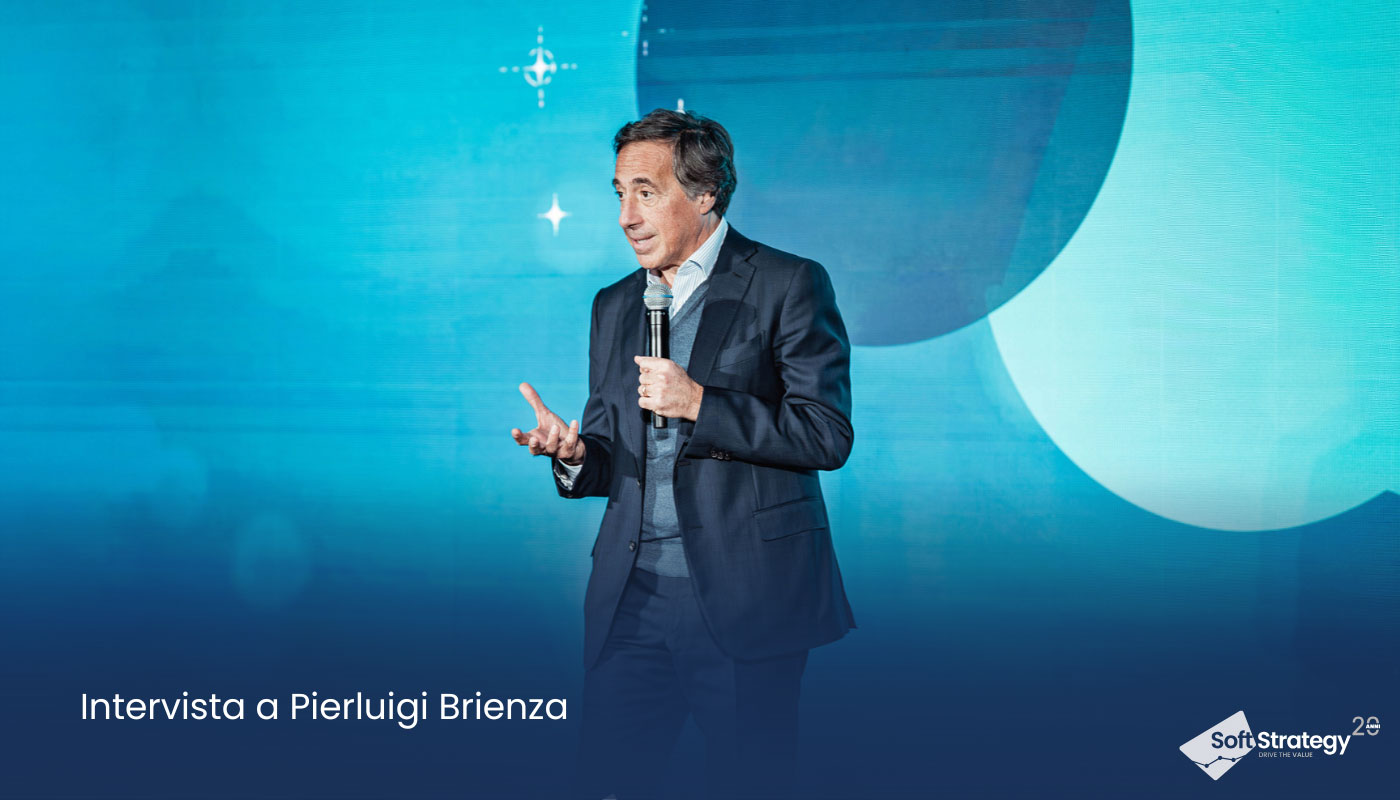
An interview with the Chairman of Soft Strategy Group.
It has been an eventful and challenging year for Soft Strategy Group. In this interview, Pierluigi Brienza, Chairman of the Group, shares his experience and his vision for the company’s future, discussing key topics including the evolution of the consulting market, the impact of artificial intelligence, work-life balance, and the Group’s strategic growth priorities.
How would you describe your first year at Soft Strategy?
It has been a very positive experience. I was already familiar with Soft Strategy and knew I was joining a well-established organization with clear values and a strong corporate culture. What I found was a Group entering a new stage of maturity, with a growing awareness of its market positioning and, as a result, greater responsibility in its strategic decision-making.
Today, it is no longer enough to pursue market opportunities opportunistically. It is essential to define a clear, selective, and consistent growth path that builds on our distinctive capabilities and delivers tangible impact for clients.
What has impressed you most about Soft Strategy?
Its professionalism – not simply in terms of technical expertise, but also in the ability to take responsibility for results. Soft Strategy positions itself as a trusted partner, focused on creating real, measurable value for its clients.
This is complemented by another important strength: flexibility. Compared with larger, more structured organizations, we can adapt quickly to changing market and client needs, supported by agile decision-making and strong internal alignment. This allows us to remain competitive, particularly in dynamic and complex environments.
How is the consulting market evolving, and what role does Soft Strategy want to play?
The consulting market is undergoing a profound transformation. On the one hand, there is increasing pressure to deliver results: clients expect more tangible value, faster execution, and collaboration models increasingly focused on outcomes. On the other, the market is becoming increasingly fragmented, with new, highly specialized players competing for high-profile projects.
In this environment, we believe the most effective positioning is not that of a generalist, but of a partner capable of combining specialist expertise, strategic vision, and execution excellence.
This is precisely where Soft Strategy intends to strengthen its position: becoming a trusted partner for our clients’ most critical transformations, with a pragmatic, results-oriented approach supported by distinctive capabilities.
What role does artificial intelligence play in your strategy?
Artificial intelligence represents a fundamental shift – not only technologically, but economically as well. It will profoundly change how we deliver services, our operating model, and, over time, pricing dynamics.
For us, AI is not simply a trend. It is a strategic priority that we are approaching in a structured way, both internally – to increase productivity and efficiency – and for our clients, helping them transform their business models.
Looking ahead, we expect a shift toward increasingly outcome-based models, where the value generated – whether through additional revenue or cost savings – will also play a central role in determining how services are priced.
Work-life balance is an increasingly important topic in consulting. What is your perspective?
Work-life balance is a key issue, but it needs to be approached realistically. Consulting requires intensity, responsibility, and the ability to manage periods of significant pressure. That is part of the profession and cannot be overlooked.
At the same time, it is the company’s responsibility to create the conditions that make this intensity sustainable over the long term. For us, this means focusing on three areas.
The first is the quality of work. Better-organized projects, clear objectives, and stronger planning help reduce inefficiencies and unnecessary peaks in workload.
The second is empowering people. Autonomy and trust allow individuals to manage their time more effectively and maintain a better balance.
The third is corporate culture. Respect for people’s time must be demonstrated in practice, not simply stated. The objective is not to work less, but to work better.
Balance is not a starting point. It is something that is built over time through consistent organizational choices and thoughtful leadership.
Soft Strategy Group brings together three complementary areas: Consulting, Technology, and Operate. How do these capabilities work together?
The integration of Consulting, Technology, and Operate is a key element of our model and an important differentiator in the market.
Traditionally, these three dimensions have been managed separately: one partner defines the strategy, another implements the solutions, and another manages day-to-day operations. This approach can create discontinuity and lead to value being lost along the way.
Our objective is to overcome this fragmentation by offering an integrated, end-to-end model that supports clients throughout the entire journey – from strategy definition and implementation through to ongoing operations.
Nethex, our Operate business, is a good example of the continuity we are creating across the Group. It can manage the entire Customer Lifecycle, from digital sales and multichannel customer care through to the IT service desk, operating as an end-to-end partner and sharing both risks and expectations with clients.
This delivers tangible benefits:
- Greater alignment between strategy and execution.
- Faster delivery.
- Stronger accountability for business outcomes.
For this model to work effectively, however, integration must also happen at a cultural level. Different areas of expertise need to work toward shared objectives through genuine collaboration rather than simple coordination.
It is a significant challenge, but also one of the key foundations on which we are building our future positioning.
What are the Group’s main growth priorities?
There are three.
The first is to strengthen our distinctive capabilities, with a particular focus on areas offering the greatest potential for growth and profitability.
The second is selective client portfolio expansion, prioritizing opportunities where we can fully demonstrate our value rather than pursuing growth opportunistically.
And, finally, there is strategic acquisitions that can accelerate our growth, both by expanding our capabilities and strengthening our market positioning.
Across all three areas, our objective is to build sustainable, consistent growth with a clear market identity.
What is your vision for the future of Soft Strategy?
Our objective is to strengthen Soft Strategy’s position as a trusted and distinctive partner for our clients’ most significant transformations, while preserving the agility that gives us a competitive advantage today.
We recognize that the market will continue to evolve rapidly and that new players will emerge, often smaller but highly specialized and extremely competitive. This makes continued investment in our capabilities, operating model, and ability to deliver tangible value essential.
The challenge is to continue growing without losing our identity – maintaining the quality, integrity, and sense of responsibility that define us while becoming even more focused on innovation, business outcomes, and measurable value creation.