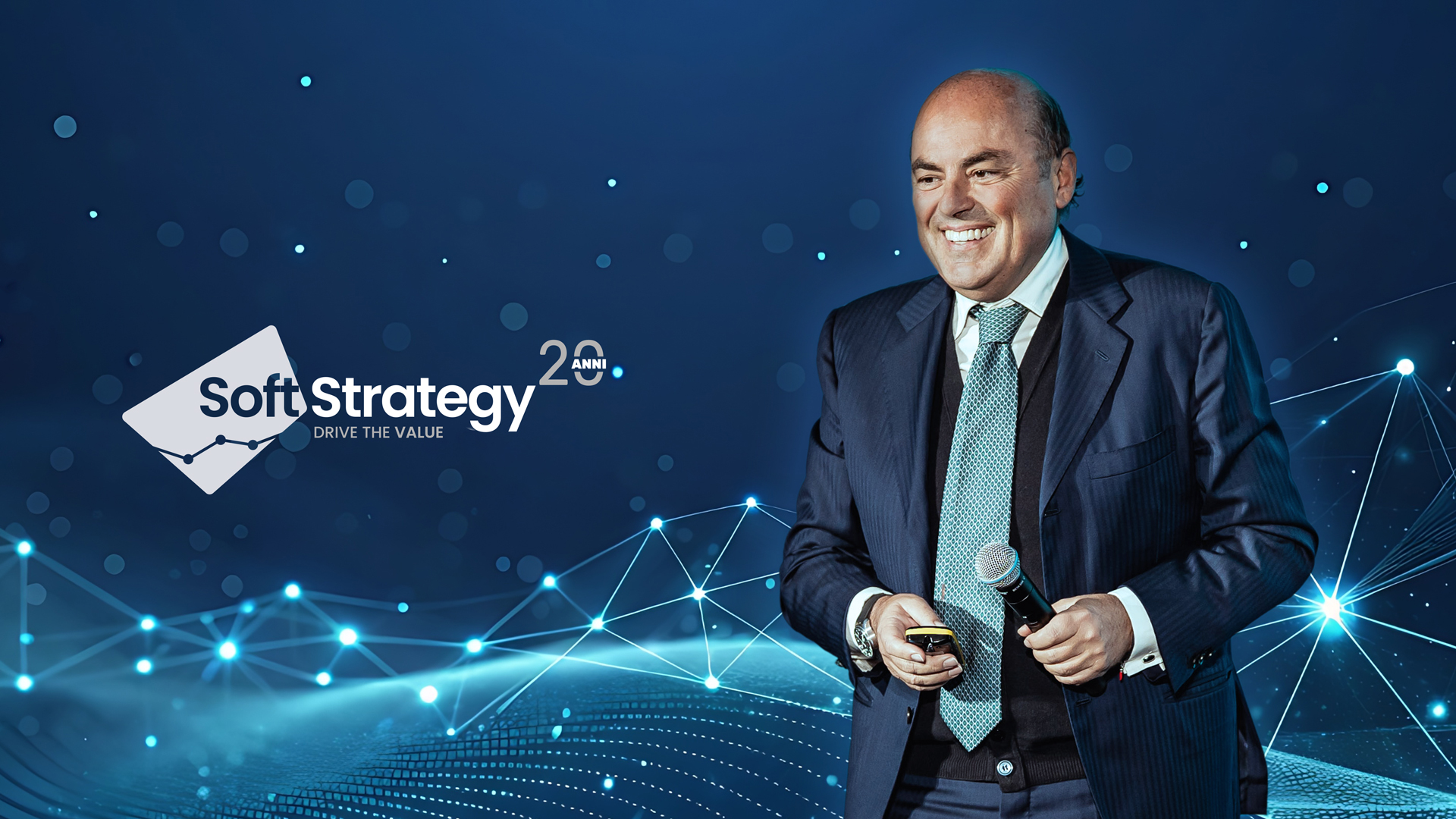
Soft Strategy celebrates its twentieth anniversary, marking two decades shaped by a strong corporate culture and a constant focus on evolving market trends. Antonio Marchese, Founder and Owner of the Group, shares his perspective.
Soft Strategy is celebrating its twentieth anniversary. How do you achieve such a milestone in the IT consulting industry?
There are many interconnected factors behind our longevity. A clear business strategy from day one. A strong corporate culture that shapes every decision we make. Continuous investment in our people. A portfolio of services that evolves alongside technological and regulatory change. A constant drive toward innovation. Above all, a commitment to treating every client as a strategic partner.
Finally, we’ve maintained a lean decision-making structure that allows us to move quickly without ever losing sight of our founding principles. When these elements work together, they create resilient organizations capable of delivering sustainable, long-term growth.
When did you realize that Soft Strategy had become a mature and well-established organization?
I don’t think there was a single defining moment. Rather, it was a series of indicators.
A company reaches maturity when it can evolve and adapt to external pressures without losing its identity. When people develop a strong sense of belonging, long-standing clients continue to place their trust in you and when your financial organization is robust enough to support sustainable growth.
Together, these factors have enabled us to grow steadily and strengthen the Group year after year.
Over the past twenty years, has the organization faced significant challenges?
Absolutely. Any company that aspires to longevity will inevitably face difficult periods. What matters is how those challenges are managed.
During difficult times, our decisions have always been guided by clarity, responsibility, and consistency with our values. We’ve never looked for quick fixes. Instead, we’ve focused on building organizational resilience – something that goes far beyond simply achieving growth.
This mindset has enabled us not only to navigate difficult business cycles, but also to emerge from them stronger and more aware.
My own role has evolved as well. I’ve gone from building the company to safeguarding its purpose, learning along the way that leadership today is defined far more by judgment, consistency, and accountability than by control.
That philosophy is reflected in the Group’s Corporate Governance structure, with CEO Emanuele Candela, Chairman Pierluigi Brienza, our Corporate Functions, General Managers, and the wider leadership team independently overseeing the day-to-day management of the Group.
Which decision has had the greatest impact on the Group’s overall trajectory?
One of our most significant strategic decisions was designing an integrated yet diversified business model.
At one point, it became clear that consulting and digital services operated according to fundamentally different dynamics. Rather than forcing them into a single organizational structure, we gave each business line its own identity and autonomy while maintaining unified governance, a shared vision, and strong operational synergies.
This approach – combining autonomy with close collaboration – has enabled every business area to specialize while remaining part of a broader, shared vision.
What has kept your client partnerships strong over the years?
It has never been about a single factor, but a consistent set of principles and behaviors upheld over time.
From the very beginning, we’ve positioned ourselves as strategic partners rather than transactional service providers. That means uncompromising reliability, continuity in our teams and expertise, growing alongside our clients rather than independently of them, transparency – especially during periods of uncertainty – and a long-term perspective where mutual value creation always takes precedence over individual projects.
These are the foundations of relationships that endure well beyond the completion of any single engagement.
Has there been one guiding principle throughout Soft Strategy’s journey?
Yes. It can be summarized in three interconnected principles: people come first; clients are partners, not simply customers; and creating long-term value must always be the ultimate objective.
These aren’t slogans. They’re the principles we apply to every decision we make.
Whenever we face an important choice, we ask ourselves: Are we creating value for the client? Are we thinking long term? Are we giving our people the tools they need to succeed?
If the answer isn’t “yes” to all three questions, we’re probably heading in the wrong direction.
Consulting has changed dramatically over the past twenty years. How has Soft Strategy navigated that transformation?
Twenty years ago, the consulting market revolved around long-term projects with a clearly defined scope established at the outset.
Today, clients expect continuous transformation: digital technologies, data and AI, end-to-end process reengineering, and integrated Change Management.
Soft Strategy hasn’t simply adapted to this evolution – we’ve actively driven it.
We’ve evolved from delivering traditional IT consulting services to enabling end-to-end transformation by combining advisory with System Integration. Through our Group ecosystem – including Nethex, our Operations company – we’ve complemented these capabilities with Business Process Outsourcing (BPO), creating a truly end-to-end offering for our clients. Rather than simply following market trends, we’ve consistently sought to anticipate where the market was heading.
What has been the most significant shift in your market positioning?
The biggest transformation has been moving from being an IT consulting provider to becoming a transformation partner.
That’s much more than a marketing statement. It means our responsibility doesn’t end when a project is delivered – it begins there.
We measure success by the real business impact our projects generate and by the tangible results our clients achieve after implementation.
This approach requires courage because it means accepting greater responsibility and exposure. In return, it creates deeper, longer-lasting relationships built on trust.
Many of the capabilities you now consider essential simply didn’t exist in 2006. How did you bridge that gap?
Many of today’s critical capabilities – artificial intelligence, advanced analytics, digital complexity management, and organizational Change Management leadership – were barely imaginable as professional disciplines in 2006.
Our strategy was never to chase every emerging trend. Instead, we focused on identifying the capabilities that would become fundamental over time.
Once identified, we embedded them into our DNA, fundamentally transforming the way we create value. This wasn’t simply about technical training; it represented a complete reinvention of our market offering.
In an increasingly competitive market, what makes Soft Strategy stand out?
We differentiate ourselves through a combination of factors: a clear strategic vision, strong execution capabilities, and genuine accountability for results.
We operate in environments where complexity isn’t an obstacle to overcome but a capability to cultivate.
That requires a deep understanding of our clients’ needs, long-term relationships, and a willingness to take responsibility.
It’s not a positioning that can easily be replicated because it’s built on corporate culture, cohesive teams, and the discipline to say no to opportunities that aren’t aligned with our mission.
These qualities take years to develop, but they’re well worth the investment.
Looking ahead, how do you see Soft Strategy five years from now? What will its market position be, and which strategic initiatives will define its future?
Given the pace at which markets and technologies continue to evolve, making realistic predictions five years into the future is far from straightforward.
My hope is that Soft Strategy will continue to strengthen its position as a trusted strategic partner for its clients.
I also expect us to consolidate our leadership in the Public Administration sector while further expanding our presence across the Transport, Utilities, and Energy industries.